
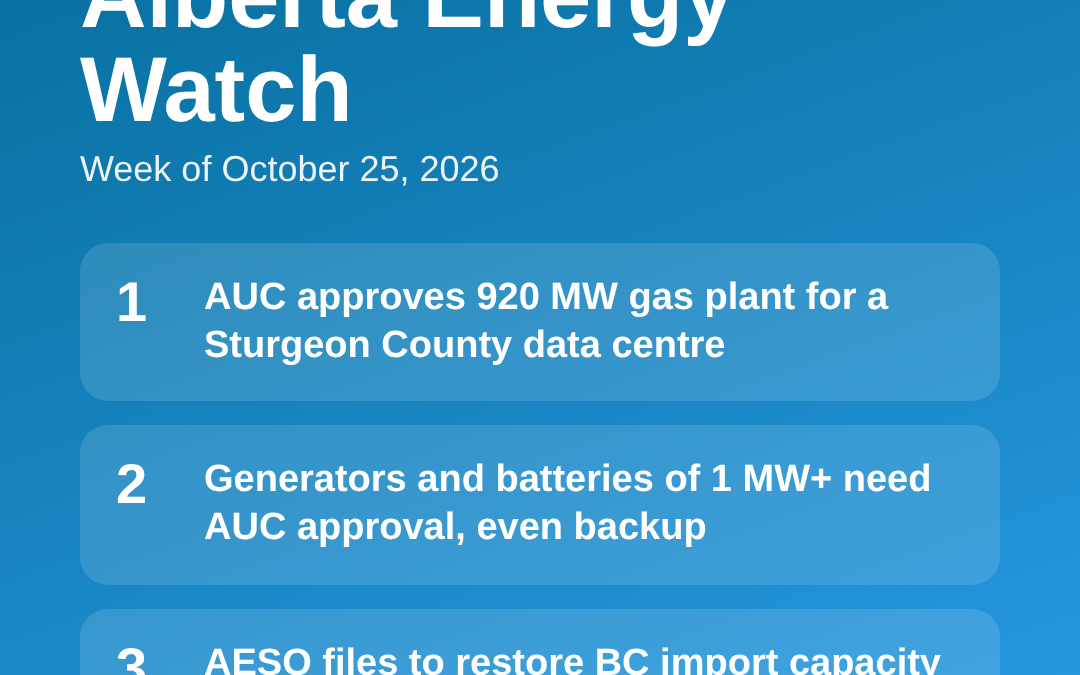
Alberta Energy Watch is our Friday companion to the Monday Alberta Energy Market Report: Monday is prices, Friday is the context behind them. Three stories from this week that touch an Alberta household or small business, in our own words, with the original sources linked at the bottom.
Verified against the original decisions, announcements and filings on October 30, 2026.
1. The AUC approves a 920 MW gas plant built to power a data centre near Gibbons
In a decision dated October 23 and reported widely this week, the Alberta Utilities Commission approved, with conditions, the Beacon AI Centers Heartland Project thermal power plant, about seven kilometres east of Gibbons in Sturgeon County’s Industrial Heartland. The plant will use 200 natural gas engines of roughly 4.6 MW each, for a nominal 920 MW, and under normal conditions will send about 800 MW to a data centre built on the same site. The applicant, Heartland Power Generation LP, expects construction to start in the fourth quarter of 2026 and the plant to be in service in the fourth quarter of 2027. The AUC was clear that its approval covers the power plant only: it does not regulate data centres, and a future connection to the provincial grid will need separate applications.
What it means for you: the AUC noted the project fits the province’s “bring your own generation” policy for data centres: the data centre is planned to run mostly on power built for it, rather than drawing that load from the grid that serves homes and businesses. The decision itself notes the developer sees possible benefits from later connecting to the grid, including selling excess power. Nothing changes on your bill because of it. It is one more piece of how Alberta is handling very large new loads, a factor we track because it shapes the long-term wholesale market that variable rates follow.
2. Planning a big generator or battery? The AUC says 1 MW or more needs approval, even for backup
On October 26, the AUC issued a reminder that any power plant or energy storage facility with a total capability of one megawatt or more needs its approval before construction or operation. That applies whatever the equipment is for: on-site use only, temporary generation, emergency or backup power, or units that never send power to the grid. Capacity is counted for the whole site, so several smaller generators are added together, and a later expansion that takes a site to 1 MW or more needs approval before the new units go in. Projects from 1 MW up to just under 10 MW can use a shorter checklist application under AUC Rule 007. The AUC also noted that backup generators are not exempt from its noise rule (Rule 012) during testing, maintenance and other non-emergency running, and that building or running an unapproved facility can lead to enforcement, including financial penalties.
What it means for you: one megawatt is 1,000 kilowatts, so a typical home standby generator is far below the threshold (that comparison is ours, not the AUC’s). Where it can matter is on farms, larger commercial and industrial sites, and anyone combining several generators or adding a large battery. If you are planning a setup like that, check with the AUC before you buy or build, at 310-4AUC (310-4282) or info@auc.ab.ca. The approval rules are the same whichever electricity retailer you use.
3. The AESO files to restore Alberta’s import capacity from British Columbia
On October 29, the Alberta Electric System Operator filed a needs application with the AUC for the Alberta–British Columbia Intertie Restoration project. The 500 kV line that links the two provinces was designed for more, but reliability and equipment limits have held imports to about 800 MW. The AESO’s plan would bring import capability back to approximately 950 MW by adding a new substation with series compensation on the line, raising the line’s thermal rating, and installing a larger transformer at the Bennett substation near Langdon. AltaLink’s estimate for the Alberta work is about $179 million (accurate to within 30 per cent), with a scheduled in-service date in the first quarter of 2034; BC Hydro has committed to fund the work on its side at no cost to Alberta ratepayers. Alberta’s Transmission Regulation required this filing by December 31, 2026, as a step toward restoring the intertie to import at or near 1,200 MW.
What it means for you: imports matter most in Alberta’s tightest hours. On Thursday, October 29, AESO data shows the pool price above $800/MWh from 5 p.m. to 8 p.m., after a morning peak of $556.65/MWh. More import room is one of the tools that can help in hours like those, but this project is years away and needs AUC approval first, and once approved, transmission costs are recovered through the regulated delivery side of bills. We will report on it as the proceeding moves. It is a factor to watch, not a forecast.
On the calendar: applications for the province’s one-time $100 Alberta Energy Rebate close tomorrow, October 31. Alberta Time takes effect Sunday, November 1, so clocks will not fall back. The same day, Winter Rules protection from disconnection extends to home natural gas service (home electricity has been covered since October 15). The UCA’s free noon Power Hour webinars continue on November 4 (utility choices for seniors), November 10 (reading your bill and comparing retailers) and November 18 (understanding utilities in Alberta). Registration for the AUC’s November 17 meeting on distribution system plans closes November 10.
Sources
- Alberta Utilities Commission — Decision 30518-D01-2026, Beacon AI Centers – Heartland Project Thermal Power Plant, October 23, 2026: auc.ab.ca (PDF)
- The Globe and Mail — “Alberta regulator approves power plant project for data centre near Edmonton,” October 26, 2026 (coverage of the decision): theglobeandmail.com
- Alberta Utilities Commission — Announcement, “Clarification on approval requirements for power plants and energy storage facilities,” October 26, 2026: auc.ab.ca (PDF)
- Alberta Electric System Operator — Alberta–British Columbia Intertie Restoration Needs Identification Document, October 29, 2026: aeso.ca (PDF)
- Alberta Electric System Operator — Alberta–British Columbia Intertie Restoration (7006) project page: aeso.ca
- Alberta Electric System Operator — Historical pool price report, October 29, 2026: ets.aeso.ca
- Government of Alberta — Alberta Energy Rebate: alberta.ca
- Government of Alberta — Alberta’s new time system (ABT): alberta.ca
- Utilities Consumer Advocate — Winter Rules and Power Hour webinars: ucahelps.alberta.ca
- Alberta Utilities Commission — Announcement, “Distribution system plans released and future process,” October 20, 2026: auc.ab.ca (PDF)
All figures verified against the sources above, October 30, 2026. Pool prices are AESO hourly settled prices (hours ending 6 p.m. to 8 p.m. on October 29 for the evening figures, hour ending 9 a.m. for the morning peak). Cost estimates and schedules are the applicants’ and the AESO’s own and can change through the regulatory process.
Get Energy is a competitive retailer in Alberta, a tradename of Utility Network & Partners Inc. Alberta has no residential time-of-use pricing. Nothing here is advice about your own contract.
Recent Comments