
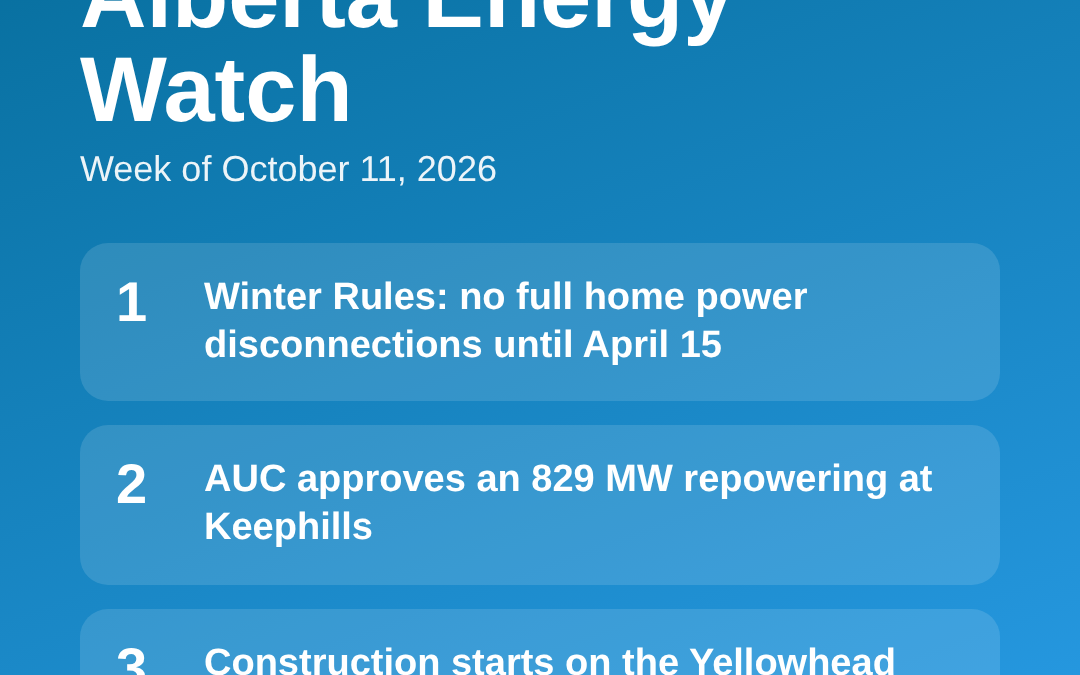
Alberta Energy Watch is our Friday companion to the Monday Alberta Energy Market Report: Monday is prices, Friday is the context behind them. Three stories from this week that touch an Alberta household or small business, in our own words, with the original sources linked at the bottom.
Verified against the original releases, decisions and filings on October 16, 2026.
1. Winter Rules are in effect: no full disconnections of home power until April 15
As of October 15, residential electricity service in Alberta cannot be fully disconnected until April 15, the Government of Alberta confirmed on October 14. Natural gas follows on November 1: the Utilities Consumer Advocate (UCA) says home gas service cannot be disconnected between November 1 and April 14. If a power bill goes unpaid in the meantime, the distribution company can install a load limiter at the retailer’s request. A limiter keeps enough power on for the furnace, the fridge, one stove element and a few lights, but appliances such as an electric dryer, an electric stove or heat tape will trip it. Separately, and in any season, a disconnection is not allowed when the temperature is forecast to fall below zero within 24 hours of the planned cut-off.
What it means for you: Winter Rules protect a home from losing heat. They do not pause the bill, and anything still owing in the spring can lead to disconnection then. They also do not cover commercial meters, so a small business account has no winter protection. If you are falling behind, call your retailer now to set up a payment arrangement rather than waiting for a limiter. The UCA (310-4822) can help with payment plans, disputes and reconnection, and it will contact households that are already disconnected to help get them back on before the cold.
2. The AUC approves an 829 MW gas-fired repowering at TransAlta’s Keephills plant
In Decision 30511-D01-2026, dated October 7, the Alberta Utilities Commission approved TransAlta’s plan to rebuild the retired Keephills Unit 1, about 60 kilometres west of Edmonton and south of Wabamun Lake, as a natural gas combined cycle plant. The project adds two gas turbines and heat recovery steam generators to the existing unit, for 829 MW gross and 809 MW net. All of the new equipment sits inside the existing plant fence line. The Commission found the project in the public interest, citing its contribution to the reliability of Alberta’s electricity supply and the reuse of an established industrial site. TransAlta expects construction to start in the fourth quarter of 2027 and the plant to enter service in the fourth quarter of 2030.
What it means for you: nothing on your bill changes because of this decision. In Alberta’s competitive market, power plants are built by private companies and are not paid for through the regulated delivery charges on your bill. What matters for households is supply: with large new loads such as data centres asking to connect, more flexible generation coming online around 2030 is part of what will shape the wholesale price that variable rates follow. It is a long-range factor, not a forecast.
3. Construction starts on the Yellowhead natural gas pipeline east of Edmonton
On October 13, Canadian Utilities, the parent of ATCO Gas and Pipelines, marked the start of construction on the Yellowhead Pipeline. The 235-kilometre line will run from near Peers to Fort Saskatchewan and carry 1.1 billion cubic feet of natural gas a day into Alberta’s Industrial Heartland. The company puts the cost at an estimated $2.9 billion and expects the line in service by late 2027. It is a utility pipeline owned and operated by ATCO Pipelines and regulated by the Alberta Utilities Commission, which approved the project in July after confirming the need for it in an earlier decision. The company says its capacity was fully contracted before regulatory approval was complete.
What it means for you: this line is built to serve industrial growth, power generation and other large users in the Heartland, not to change what a household pays for gas this winter. Because it is a regulated utility asset, the costs ATCO Pipelines recovers for it go through AUC rate proceedings, which are public. Your natural gas bill this winter still comes down to the gas price on your plan and the delivery charges set by your distributor.
On the calendar: the UCA’s free Power Hour webinars continue at noon on October 21 (small businesses, including rate classes and demand charges) and October 28 (rural Alberta). Applications for the province’s one-time $100 Alberta Energy Rebate close October 31. Alberta Time takes effect November 1, so clocks will not fall back; check any thermostat or block-heater timer that adjusts for daylight saving time on its own.
Sources
- Government of Alberta — “No chill, no cut-offs: winter utility rules taking effect,” October 14, 2026: alberta.ca
- Utilities Consumer Advocate — Winter Rules: ucahelps.alberta.ca
- Utilities Consumer Advocate — Load limiters: ucahelps.alberta.ca
- Alberta Utilities Commission — Decision 30511-D01-2026, TransAlta Corporation, Keephills Unit 1 Repowering Project, October 7, 2026: auc.ab.ca (PDF)
- TransAlta — Keephills 1 Repowering Project: transalta.com
- Canadian Utilities — “Canadian Utilities breaks ground on the Yellowhead Pipeline,” October 13, 2026: newswire.ca
- ATCO Pipelines — Yellowhead Pipeline Facility Application to the AUC (ownership, regulation, need approval in Decision 29318-D01-2025): auc.ab.ca (PDF)
- Utilities Consumer Advocate — Power Hour webinars: ucahelps.alberta.ca
- Government of Alberta — Alberta Energy Rebate: alberta.ca
- Government of Alberta — Alberta’s new time system (ABT): alberta.ca
All figures verified against the sources above, October 16, 2026. Plant size and timing in story 2 are from the AUC decision; pipeline cost, capacity and in-service timing in story 3 are the company’s own figures.
Get Energy is a competitive retailer in Alberta, a tradename of Utility Network & Partners Inc. Alberta has no residential time-of-use pricing. Nothing here is advice about your own contract.
Recent Comments